Stacking thirds
Here is a visualization of how to stack thirds on the Ionian Mode (Major Scale).
We only need two elements:
The minor third 
The major third 
Here's the process, step by step:
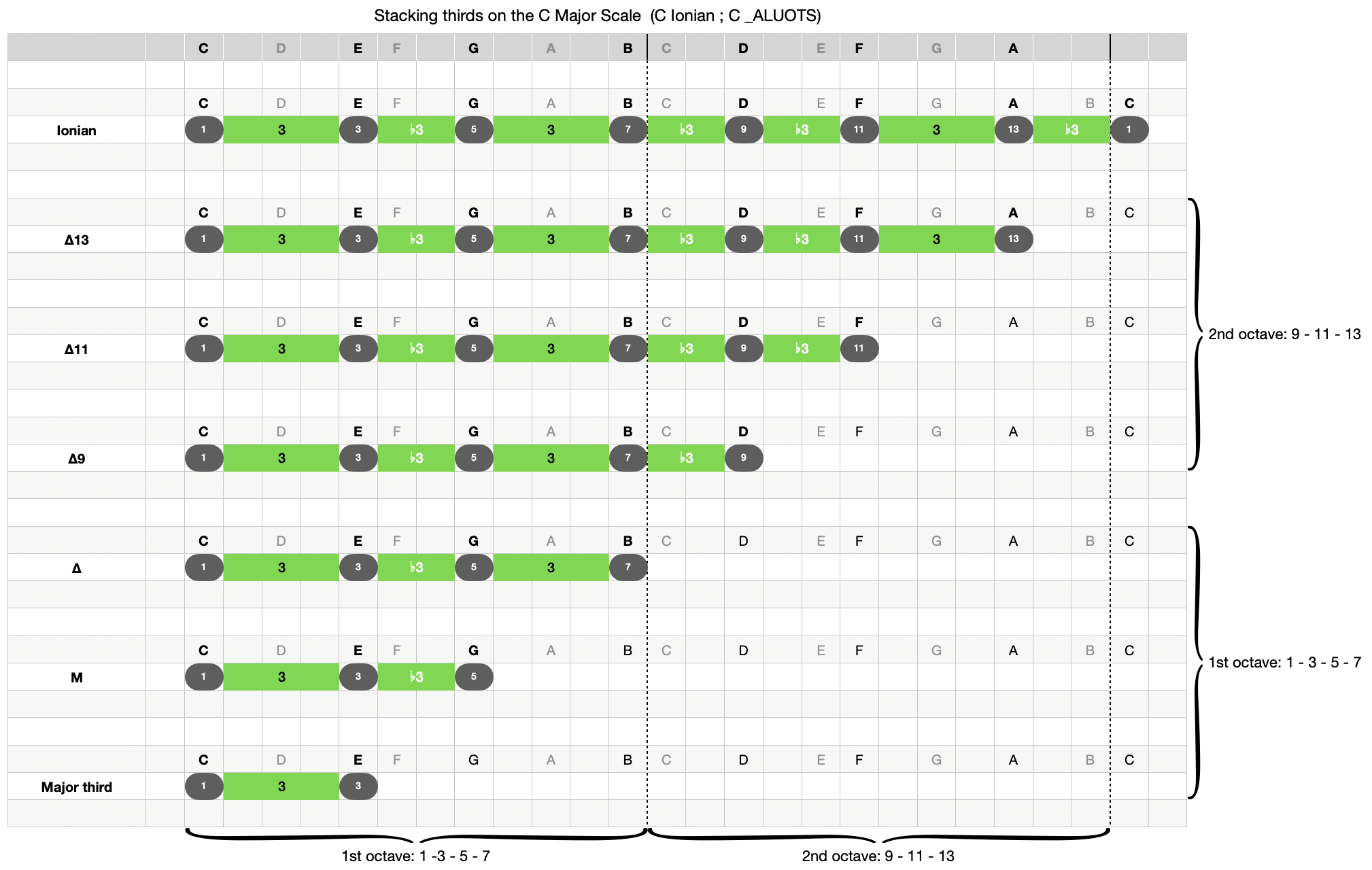
In the first octave we use degrees 1 - 3 - 5 - 7
In the second octave we have the extensions 9 - 11 - 13
Now here's the result when we apply the same principle starting from degrees two, three, four,… and seven of the scale:
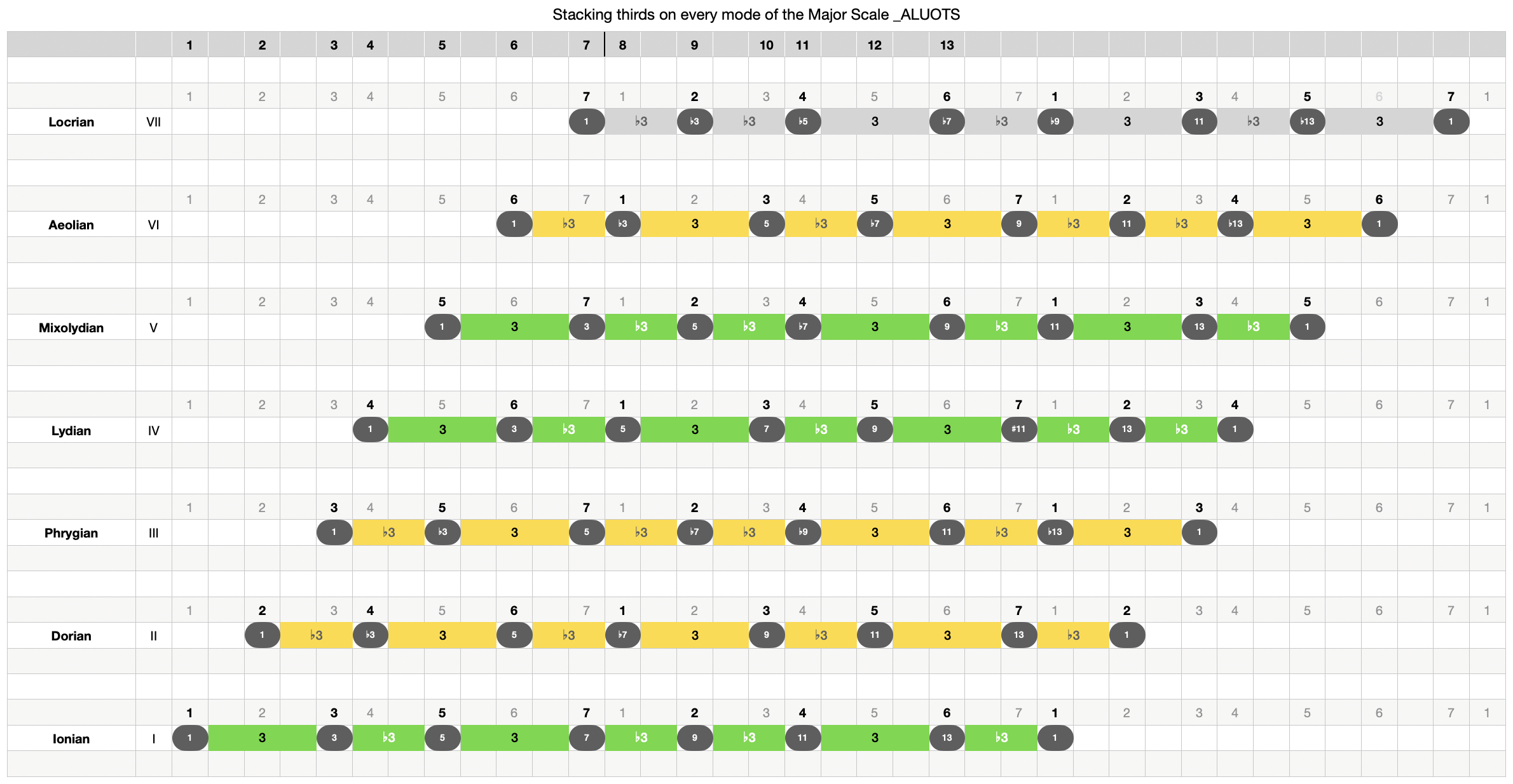
As you can see, the result is always different. We have obtained the tertian chords of the Modes of the scale.
Now to analyze the scales, we place each scale with its first degree on 1. For each scale you can see what the chords look like.
In the first octave we have the triads and tetrads. When we go further, we get the extended chords.
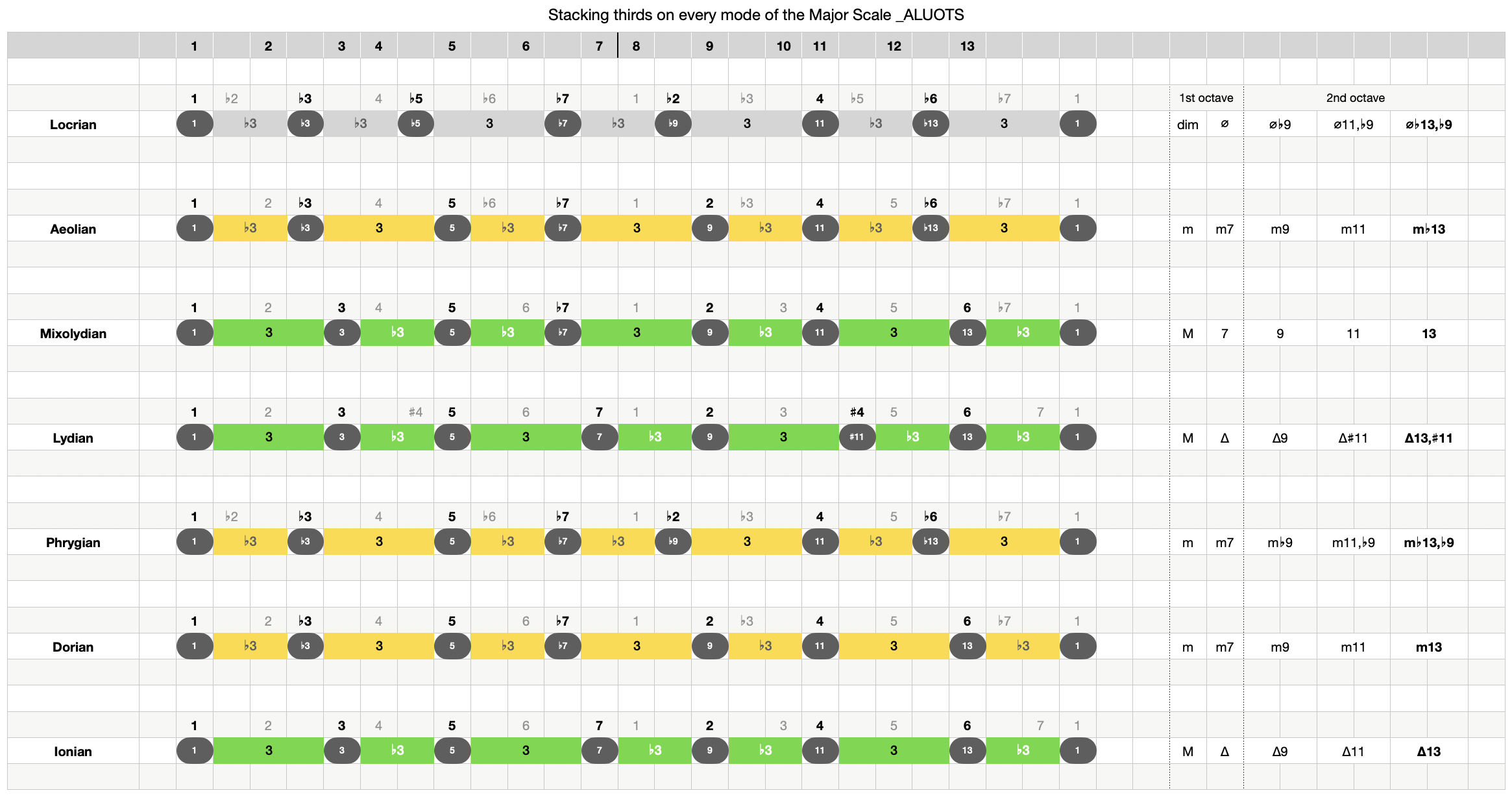
A chord symbol has three parts: the basic shape of the chord, the highest degree included, and any degrees that are different from their natural position.
How to name a chord?
The principle is:
Give the first degree the name of the note
- Indicate the higher degree of the chord
- Indicate only the degrees that are not in their natural position
Seeing & Thinking
When you see the degrees of a scale, you see:
1 - 2 - 3 - 4 - 5 - 6 - 7
A good tip is to think of them split into two groups:
1 - 3 - 5 - 7 and 2 - 4 - 6
So you have:
1 - 3 - 5 - 7 and 9 - 11 - 13
Example with the Lydian Mode:
1 - 2 - 3 -♭5 - 5 - 6 - 7 (on this scale♭5 is ♯4)
Split 1 - 3 - 5 - 7 and 2 -♭5 - 6
So you have 1 - 3 - 5 - 7 and 9 - ♯11 - 13
The 13th chord is Δ13,♯11
When you see the chord Δ13,♯11
Δ means 1 - 3 - 5 - 7 Natural 3, Natural 5, Major 7
13 is the highest degree of the chord
♯11 is the altered 4: ♯4
9 is not mentioned, so it means Natural 2